Visual Help System
Product Design
This project was completed as part of an Inclusive Design course at Kyushu University, where our team of six was paired with a design partner in their twenties who navigates daily life primarily in a wheelchair due to cerebral palsy. The goal of the course was to practice inclusive, human-centered design by spending real time with our design partner, understanding their lived experience, and developing a concept that could meaningfully improve their experience in public spaces.
Client:
Kyushu University
Role:
Design Strategist
Year:
2025


Explore the full story –
Challenge
Through ethnographic field research, we accompanied our design partner through train stations, cafés, and bookstores to observe firsthand the friction points they encountered in everyday life. Many of the challenges were not caused by the disability itself, but by the systems and social dynamics around them. In many situations, staff members communicated with us rather than directly with our design partner. They were unable to press elevator buttons independently or hold a menu while managing other tasks. Asking strangers for help required a level of social effort that often felt unnecessarily high for simple interactions.
Objective
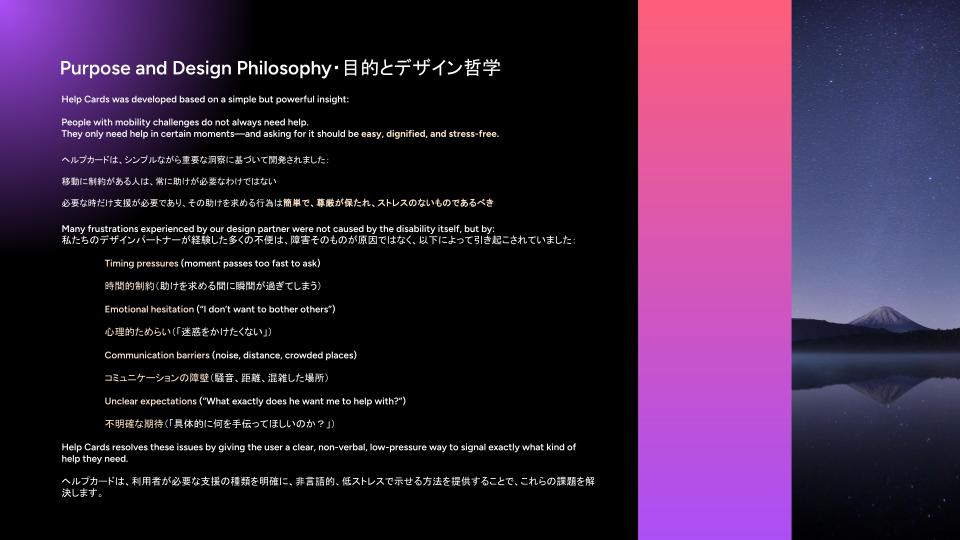
The goal was to design a system that would allow our design partner to request help in a way that felt natural, dignified, and low-pressure, without relying on speech, gestures, or lengthy explanation. The solution also needed to work across different languages and levels of familiarity, ensuring it could be understood quickly in public environments.
Results
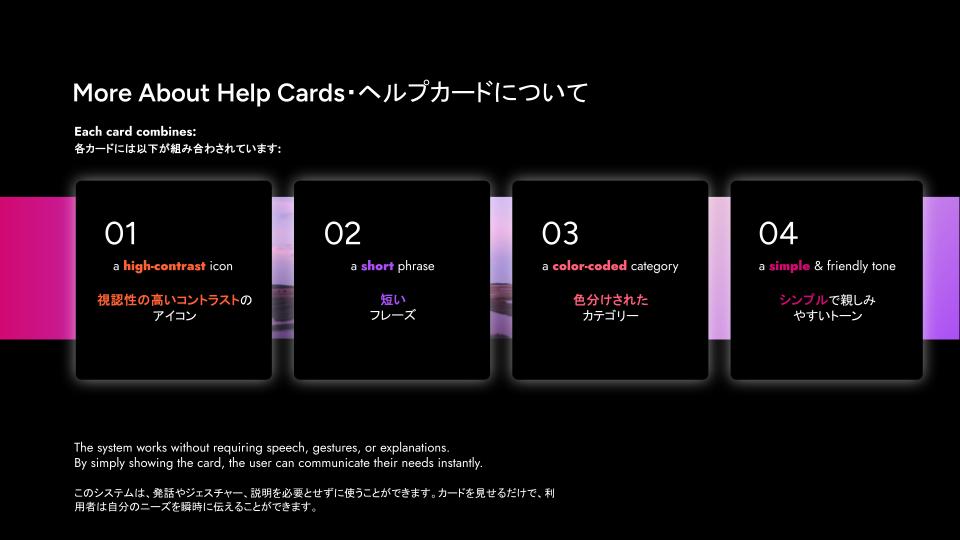
The final concept, Help Cards, is a situational visual request system that enables users to communicate their needs in a clear, non-verbal, and low-pressure way. Rather than acting as a permanent label, the system is designed to be flexible and voluntary, used only when needed in specific situations. It allows users to communicate without explanation, reducing friction in public interactions. The system was also designed with broader applicability in mind, extending beyond wheelchair users to include foreign tourists, elderly individuals, people with temporary injuries, and individuals with speech or language barriers.